
Mika's secret · eight of eight
The Battle of the Delta
Mika was not guarding a treasure: she was guarding a battle. More than three thousand years ago, a pharaoh had it carved in stone so that no one would forget it. It is yours: download it, print it and hang it where everyone can see it.
What you are looking at
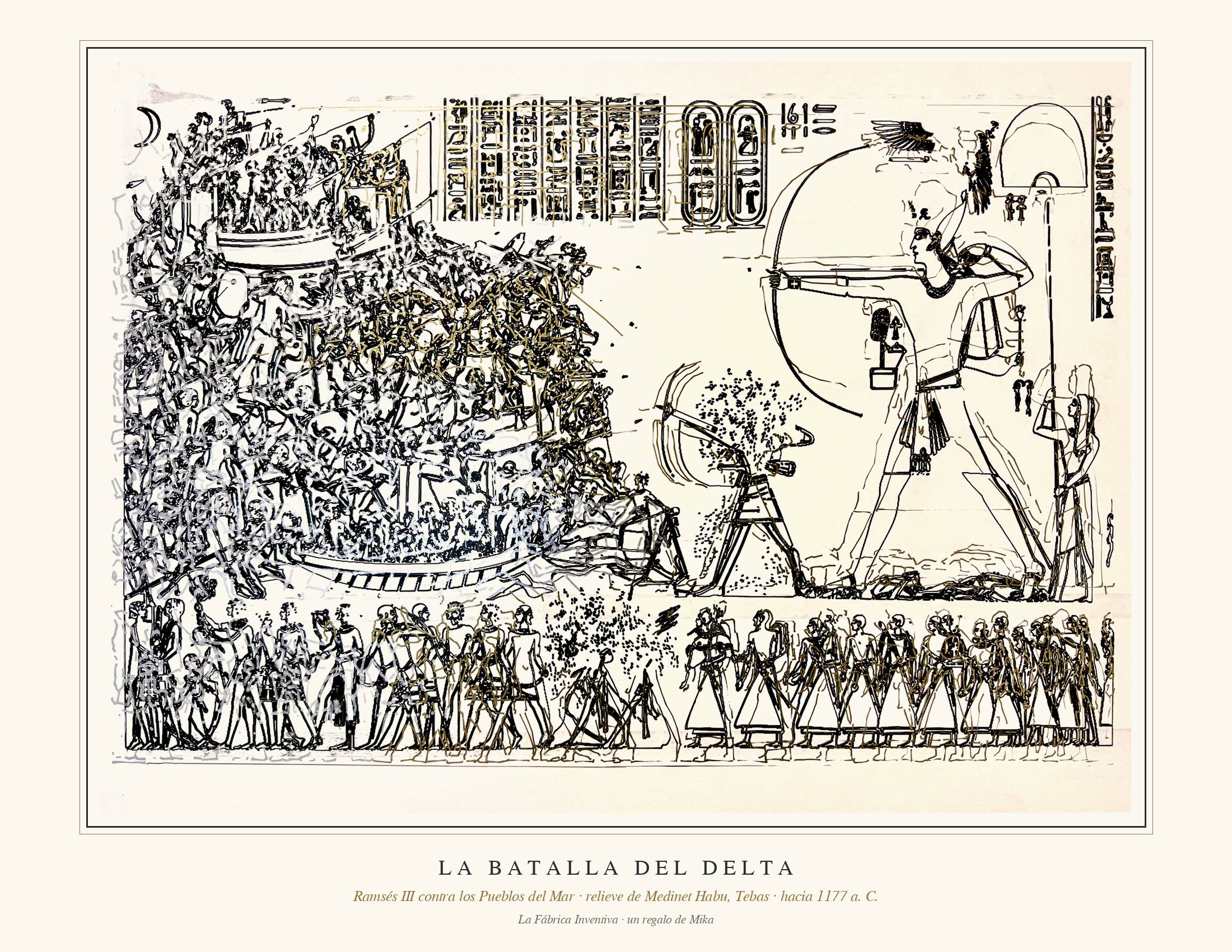
Around 1177 BC, the Mediterranean world was falling apart. Kingdoms that had lasted for centuries—the Hittites, the city of Ugarit, the palaces of Mycenae—fell one after another. In the middle of this collapse, warriors came by sea, and the Egyptians did not really know what to call them. They simply called them the peoples “from the islands in the middle of the sea.” Today we know them as the Sea Peoples: the Peleset, Tjeker, Shekelesh, Denyen and Weshesh, among others. They came with their families, their ships and their weapons, looking for land where they could stay.
Egypt was next. In the eighth year of his reign, the pharaoh Ramses III waited for them at the mouths of the Nile, in the Delta. He did not go out into the open sea: he let them enter the channels, where their ships could no longer maneuver, and from the shore he met them with clouds of arrows. His ships caught them with grappling hooks, turned them over and pushed them onto the land.
This is how the illustration tells the story. On the right, the pharaoh—huge, the way the king was always drawn—shoots his bow from the shore. On the left, the enemy ships are tangled up in the battle: look at the prows shaped like bird heads and at the helmets with horns or with feather crests. Below, the prisoners walk in a line.
Ramses III had this scene carved on the walls of his temple at Medinet Habu, in Thebes, today's Luxor. It is considered the oldest and most detailed depiction of a naval battle that we know of. Egypt survived; few kingdoms of its time could say the same.
A fact worth showing off: many people attribute it to Ramses II, who did fight the Sherden, another of those seafaring peoples, decades earlier. But this victory, and this relief, belong to Ramses III.
Mika has already seen it. She says the ships look like excellent places to sleep.